The Farms That Survived the Drought — and What Their Soil Already Knew
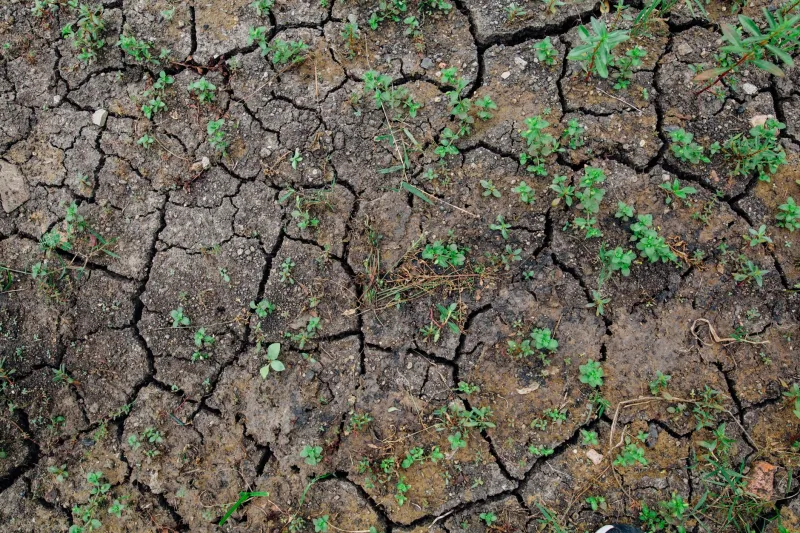
Drive through the Central Valley of California during a drought year, or across the cracked flatlands of western Kansas, and the landscape tells a stark story. Brown fields, dry irrigation channels, dust where topsoil used to be. The imagery of American agricultural drought is familiar, almost iconographic by now — the result of a climate growing less predictable and a farming system built on the assumption that water would always be available to pump or divert.
But if you know where to look, you'll find a different story playing out on certain farms — operations where the fields stayed greener longer, where cover crops held the surface together, where water from a single good rain seemed to last for weeks. These aren't farms with better luck or more expensive irrigation systems. They're farms with better soil. And the difference is increasingly a matter of survival.
Soil as a Water System
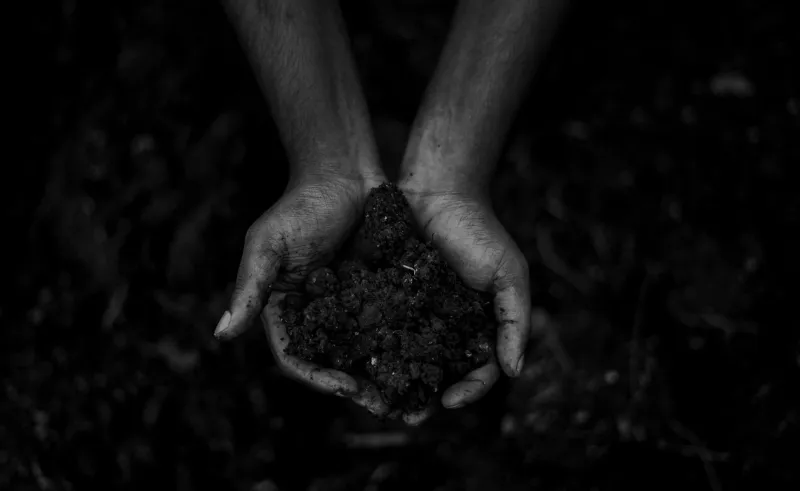
Most of us learned in school that soil is basically dirt — the stuff plants grow in. What that framing misses is that healthy soil is also one of the most sophisticated water management systems in nature. A single teaspoon of biologically active soil contains billions of microorganisms — bacteria, fungi, protozoa, nematodes — and their activity creates a physical structure in the soil that dramatically changes how water moves through it.
The key mechanism is something called aggregate stability. When soil organisms, particularly fungi, weave together particles of mineral and organic matter into stable clusters called aggregates, those structures create pore spaces in the soil — tiny channels and cavities that can absorb and hold water like a sponge. Healthy aggregated soil can absorb rainfall many times faster than compacted, biologically depleted soil, and it can hold that moisture for far longer.
Conventional tillage-based agriculture destroys this structure. Every pass of a plow or disk breaks apart aggregates, kills fungal networks, and collapses the pore structure that took years to build. Add synthetic fertilizers — which tend to favor bacterial populations over the fungi most responsible for aggregate formation — and you end up with soil that behaves more like a hard surface than a sponge. Water runs off rather than soaking in. Drought hits harder. Floods hit harder too.
Organic matter content is the other critical variable. Each percentage point increase in soil organic matter allows an acre of soil to hold roughly an additional 20,000 gallons of water. Conventional American farmland has lost an estimated 50 to 70 percent of its original organic matter over a century of industrial cultivation. That's not just a fertility story — it's a water storage story, and the numbers are staggering.
What Happened During the 2012 and 2020-2022 Droughts
The 2012 drought was the worst to hit the US corn belt since the 1950s. Crop losses were catastrophic across the Midwest — an estimated $30 billion in agricultural damage. But researchers tracking farms with different management histories found a consistent pattern: operations with higher soil organic matter, cover cropping histories, and reduced tillage experienced significantly smaller yield losses than their conventionally managed neighbors.
Gabe Brown's ranch in Bismarck, North Dakota — one of the most-studied regenerative operations in the country — became something of a case study during this period. Brown had transitioned away from tillage and synthetic inputs over the preceding decade, building soil organic matter from around 1.7 percent to over 6 percent. During the drought years that devastated neighboring operations, his farm's soil held enough moisture to maintain viable forage and crop production. His neighbors were hauling water.
Similar stories emerged from the extended drought conditions across the American West between 2020 and 2022. Farms in California, Arizona, and Colorado that had invested in cover cropping, compost application, and reduced tillage showed measurably better moisture retention and lower irrigation demand than conventionally managed parcels nearby. Several California operations reported being able to skip supplemental irrigation cycles that their neighbors couldn't afford to miss.
This isn't anecdote — it's increasingly the subject of peer-reviewed research. A 2021 study in the journal Agriculture, Ecosystems & Environment found that regeneratively managed soils in drought-prone regions retained significantly more plant-available water across multiple dry seasons compared to conventionally tilled controls.
The Groundwater Connection
The drought resilience story doesn't stop at the farm fence. How agricultural land handles water has profound implications for regional groundwater systems — the aquifers and water tables that entire communities depend on for drinking water and municipal supply.
When rain falls on compacted, low-organic-matter farmland, it runs off. That runoff carries topsoil, nutrients, and agricultural chemicals into streams and rivers — creating the algae blooms and hypoxic zones we see in the Gulf of Mexico and the Chesapeake Bay. More critically, it doesn't recharge the groundwater. Water that runs off the surface is water that doesn't percolate down to replenish aquifers.
The Ogallala Aquifer, which underlies much of the Great Plains and supplies irrigation water for a massive portion of American grain and beef production, is being drawn down far faster than it recharges. Some projections suggest portions of it could be functionally depleted within decades. The farming practices dominating that landscape — heavy tillage, minimal cover, synthetic-input monocultures — are part of why recharge rates are so low.
Regenerative farms, by contrast, act as recharge zones. Water that soaks into biologically active soil doesn't just stay there — it moves slowly downward, filtering through organic matter and microbial communities, eventually contributing to groundwater. Landscapes with high proportions of regenerative farmland could meaningfully change regional water budgets over time. It's a slow process, but the direction matters enormously.
What Farmers Are Actually Doing
The regenerative practices that build water-resilient soil aren't mysterious or prohibitively expensive, though the transition period requires real support.
Cover cropping — planting diverse mixes of grasses, legumes, and brassicas between cash crop seasons — keeps living roots in the soil year-round. Living roots feed soil microbes, maintain aggregate structure, and physically hold soil against erosion. The diversity of the mix matters: multi-species covers build more complex microbial communities than single-species plantings.
Reduced or no-till systems protect the aggregate structure that conventional tillage destroys. The shift away from tillage is one of the most impactful changes a farmer can make for soil water retention, though it requires adapted weed management strategies.
Compost and organic matter additions directly rebuild the water-holding capacity of depleted soils. Farms transitioning from conventional systems often see measurable improvements in organic matter within three to five years of consistent compost application.
Managed grazing — moving livestock across pastures in patterns that mimic natural herd movement — has been shown to dramatically increase organic matter accumulation in grassland soils while stimulating root growth and microbial activity.
Food Sovereignty Is a Water Issue
When we talk about food sovereignty — the right of communities to define their own food systems — water security is inseparable from that conversation. A food system built on depleting aquifers, degrading water-holding soils, and ignoring regional water cycles is not a resilient food system. It's a food system on borrowed time.
The farms that survived recent droughts with less damage didn't just protect their own bottom lines. They demonstrated something the rest of agriculture needs to learn quickly: that the soil is not just a growing medium. It's a water bank. And right now, industrial agriculture is overdrawn.
Supporting regenerative farms — through your purchases, your advocacy, and your willingness to pay prices that reflect real ecological value — is a vote for a food system that can actually weather what's coming. The soil already knows what to do. We just have to stop getting in its way.