Your Grocery Cart Is Draining the Aquifer: The Water Footprint Nobody Puts on the Label
There's a number missing from every grocery store receipt. It doesn't show up on nutrition labels, it's never announced by a produce manager, and no algorithm will surface it on your grocery app. But it's arguably the most important figure attached to the food you eat: how much water it took to grow.
Not the water you used to rinse your lettuce. The water that was pulled from rivers, diverted from streams, or pumped from underground aquifers hundreds of feet below the surface — water that, in many parts of the country, took thousands of years to accumulate and is now being withdrawn in decades.
This is the hidden water crisis. And your grocery cart is directly connected to it.
The Aquifer Problem Is Already Here
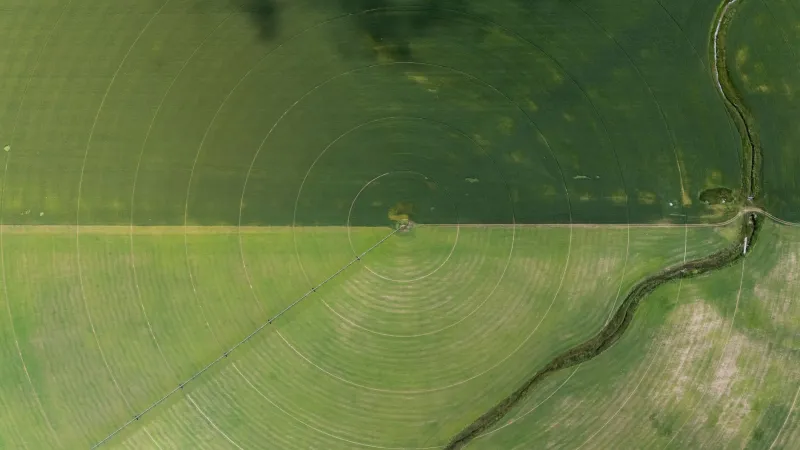
The Ogallala Aquifer stretches beneath eight Great Plains states, from South Dakota down to Texas. It's one of the largest underground freshwater reserves on the planet, and it irrigates roughly 30% of all groundwater-fed farmland in the United States. It grows your corn. Your beef. Your cotton. Your high-fructose corn syrup.
It's also disappearing. In parts of Kansas, Oklahoma, and Texas, water levels have dropped by more than 150 feet since large-scale irrigation began in the mid-20th century. The natural recharge rate — the speed at which rainwater filters back down to replenish the aquifer — is about half an inch per year in some areas. Current extraction rates are 30 to 40 times faster than that.
The Ogallala gets most of the headlines, but it's not alone. California's Central Valley aquifer is sinking — literally causing the ground to subside — from over-pumping. Arizona's water table has dropped so severely that some rural communities are trucking in drinking water. This isn't a future problem. It's happening right now, in the fields growing your food.
Not All Foods Are Equal When It Comes to Water
Here's where your choices matter more than you might think. Different foods have wildly different water footprints, and the farming method used to grow them can swing those numbers dramatically.
Conventionally grown almonds require about 1.1 gallons of water per nut — a figure that made headlines during California's drought years and never quite left the conversation. Beef raised in feedlot systems can require over 1,800 gallons per pound when you account for the water embedded in the feed crops. Conventional cotton, which isn't food but often grown on the same water-stressed land, uses roughly 700 gallons per pound.
But here's what those statistics miss: the farming method matters as much as the crop itself.
A conventionally tilled cornfield in Nebraska is a water-losing system. Bare soil between rows evaporates moisture rapidly. Synthetic fertilizers disrupt soil biology, reducing the ground's ability to absorb and hold water. Compacted earth from heavy machinery sends rainfall running off the surface rather than soaking in. The water that does get absorbed often carries nitrates with it, contaminating the aquifer it's supposed to replenish.
A regeneratively managed field of the same corn — cover-cropped, minimally tilled, with living root systems in the soil year-round — behaves completely differently. Healthy soil structure, built by fungal networks and organic matter, can absorb water at dramatically higher rates. Studies from the Rodale Institute and the Land Institute have shown that regenerative systems can reduce irrigation needs by 20 to 50 percent while simultaneously improving groundwater quality.
The Crops That Give Water Back
Some food choices actively support water conservation, and not always in the ways you'd expect.
Legumes — beans, lentils, peas — are among the most water-efficient protein sources available, requiring a fraction of the water needed to produce an equivalent amount of animal protein. They also fix nitrogen in the soil, reducing the need for synthetic fertilizers that can leach into groundwater.
Perennial crops are another undersung hero. Unlike annual vegetables that require replanting (and soil disturbance) every season, perennials like asparagus, fruit trees, berry bushes, and certain grains maintain continuous root systems that stabilize soil and improve water infiltration year after year. The Land Institute in Kansas has spent decades developing perennial grain crops specifically to address the Ogallala crisis — their Kernza grain is now showing up in craft beers and pasta, and it uses a fraction of the water conventional wheat demands.
Pasture-raised and grass-fed livestock, when managed with rotational grazing principles, can actually help restore water cycles. Well-managed grassland holds water better than bare or compacted soil. The key word is managed — overgrazing destroys that benefit entirely.
What to Look for at the Store and the Market
You can't see a water footprint on a package, but there are signals worth learning to read.
Regenerative certifications are the most meaningful indicator that a farm is actively building soil health — and soil health is water health. Look for Regenerative Organic Certified (ROC) or products from farms that openly describe their water management practices.
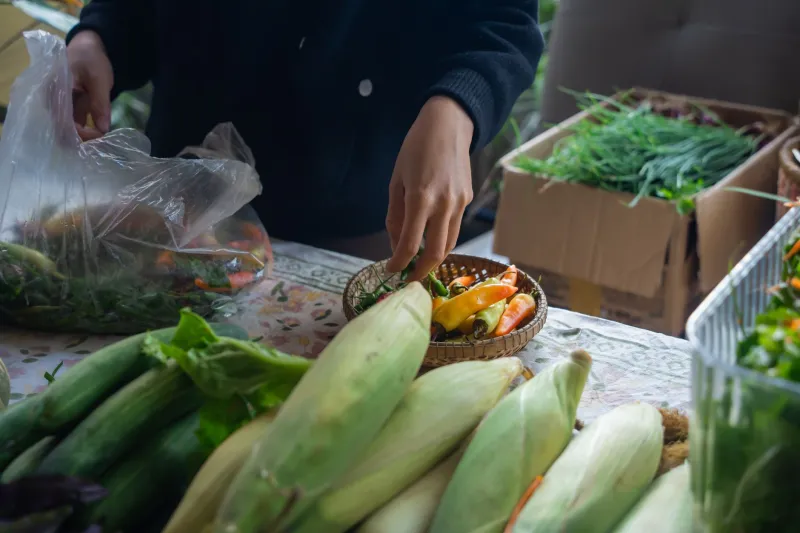
Regional sourcing matters enormously. A tomato grown in drought-stressed California and shipped to the East Coast carries a much heavier water burden than one grown by a local farmer using drip irrigation and compost-enriched soil in a wetter climate. Farmers' markets are your clearest window into this — you can ask directly how a farm irrigates.
Dry-farmed produce is a specific and increasingly visible category worth seeking out. Dry farming means growing crops with little to no irrigation, relying on soil moisture and careful land management. Dry-farmed tomatoes, potatoes, and wine grapes are particularly prized — they tend to have more concentrated flavor, and they prove that water-intensive farming isn't the only way.
Reduce beef, don't eliminate nuance. The conversation around beef and water is real but oversimplified. Feedlot beef from water-stressed regions is a genuine problem. Regeneratively raised, grass-finished beef from well-watered pastures in the Southeast or Pacific Northwest is a different animal, literally and ecologically. The blanket advice to just eat less beef misses the farming system question entirely.
The Bigger Picture in Your Shopping Bag
None of this means you need to memorize water footprint charts before every grocery run. But it does mean that the cumulative weight of your food choices — over weeks, months, years — adds up to a real vote on how American agriculture manages its most essential resource.
The farms that are building soil organic matter, rotating crops, keeping ground covered, and minimizing synthetic inputs are, almost universally, the same farms using less water and protecting groundwater quality. The overlap isn't coincidental. It's systemic.
The Ogallala won't recover in our lifetimes regardless of what we do. But the rate of depletion is something farming practices — and food demand — can influence. Choosing food from regenerative and water-conscious farms doesn't just taste better or feel better. It's a material contribution to whether the aquifer your grandchildren inherit has anything left in it.
That's a number worth thinking about, even if nobody puts it on the label.