Six Dollars a Dozen: What My Farmers Market Receipt Actually Says About Class
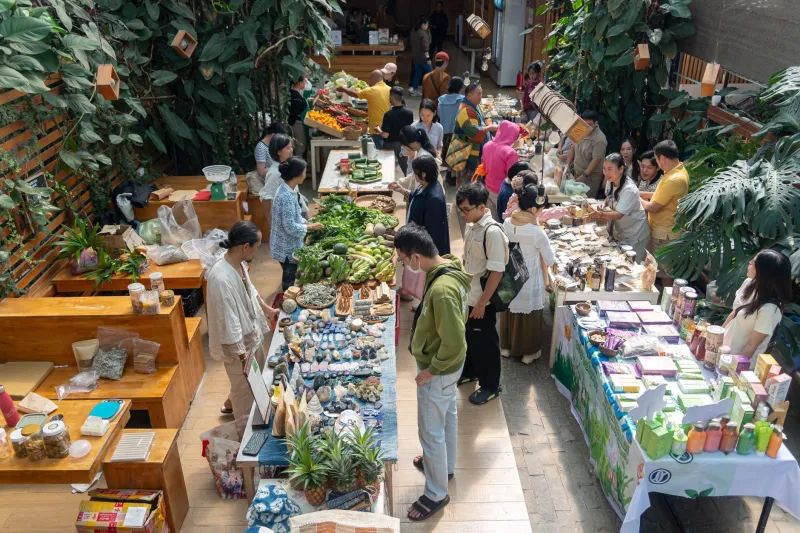
There's a moment every Saturday morning at the Portland farmers market when someone picks up a carton of eggs, sees the price, and puts it back down with a little laugh. You know the laugh. It says: this isn't for people like me.
For years, that laugh has been the default critique of the local food movement — that it's a lifestyle brand for people with disposable income and a subscription to a seed catalog. And honestly? Some of that critique lands. But after spending a month talking to shoppers, vendors, and food access coordinators about what eating local actually costs, I've come to believe the elitism narrative is both true and wrong at the same time. Which is to say: it's incomplete.
The Receipt Test
Let's start with money, because that's where the argument usually starts and ends.
I asked three friends to track a week of grocery spending — one shopping exclusively at a farmers market, one at a conventional supermarket, one splitting the difference at a discount chain. The market shopper spent about 18% more overall. But the breakdown matters: her produce costs were nearly identical to the supermarket's, and often cheaper for in-season items like zucchini, greens, and tomatoes. Where the gap opened up was in proteins, dairy, and eggs — the animal products.
That tracks with what researchers have found repeatedly: at peak season, local produce can compete with grocery pricing, sometimes beat it. The $6 dozen eggs are real, but so is the $2 bag of green beans that's fresher than anything in the supermarket cooler. The market isn't uniformly expensive. It's unevenly expensive, and most of us never learn its pricing rhythms because we've already written it off.
Who's Actually Shopping
Maria Vega sells vegetables at two markets outside Sacramento. She pushed back hard on the elitism framing when I brought it up. "People see the market, they see one neighborhood, they assume," she told me. "But my Saturday customers include families using EBT every single week. They plan. They come at the end of the day when vendors discount. They know what they're doing."
That planning is the hidden variable. Food access advocate Denise Okafor puts it bluntly: "Farmers markets have a knowledge barrier more than a pure price barrier. If nobody ever taught you that you can negotiate a bulk buy for canning, or that kale greens are often given away free, the market feels closed. Feelings of exclusion are real, even when a $3 bunch of chard technically isn't."
The Programs Changing the Math
Here's where the story gets genuinely encouraging. Double Up Food Bucks and similar SNAP-matching programs — now operating in more than half of US states — effectively cut produce prices in half for EBT users at participating markets. In Michigan, the program's home state, evaluations found participating families increased fruit and vegetable consumption significantly while farmers gained new customers. Everyone wins, which is suspicious, but the data holds.
Sliding-scale CSA models are spreading too. Farms in the Twin Cities, the Hudson Valley, and the Portland area now offer share pricing tiers where higher-income members subsidize lower-income ones. Some operate on a pay-what-you-can basis entirely. Community-supported agriculture, it turns out, can support community.
Honest Strategies for Tight Budgets
If you're stretching every dollar, here's what actually works, learned from people who do it weekly:
Shop the last hour. Vendors would rather sell at a discount than haul produce home. Ask — most will deal.
Buy seconds. Ugly tomatoes cost half as much and taste the same in a sauce.
Skip the prepared goods. The $14 loaf of sourdough is where budgets die. Buy ingredients, not artisan products.
Go heavy in August. Peak-season buying in bulk — for freezing, drying, or fermenting — is the single biggest savings move available. Winter you will thank summer you.
Ask about SNAP matching before you assume you can't afford it. Half the eligible shoppers at markets with doubling programs don't know the program exists.
So Is It Elitist?
The movement has an image problem, and pretending otherwise helps no one. Farmers markets grew up in affluent neighborhoods and carry that DNA in their yoga-pants reputation. But the infrastructure being built — SNAP doubling, sliding-scale CSAs, market incentive programs — is explicitly counter-elitist, and it's working in the places it's been funded properly.
The $6 eggs are real. So is the family stretching EBT into a week of the best vegetables they've ever eaten. Both are at the market on Saturday morning. The question isn't whether local food is elitist. It's whether we'll fund the programs that make sure it never becomes so.