The Front Yard Felony: How Your City's Rulebook Decides What You're Allowed to Grow
Here's a fun party fact: in Oak Park, Michigan, a woman named Julie Bass faced potential jail time in 2011 for planting vegetables in her front yard. Not for selling them. For growing them, in plain view of a street, in violation of a city code requiring a "suitable live plant material" — which the city interpreted to mean anything except food.
She eventually won, after national outrage made the city back down. But the ordinance she fought is still on the books in thousands of American municipalities. And most people have no idea their own city has one.
The Invisible Wall
Municipal zoning codes are the least-read literature in America, and they are quietly shaping the local food landscape. Flip through enough of them and a pattern emerges — a mid-century vision of the residential lot as ornamental space, nothing more:
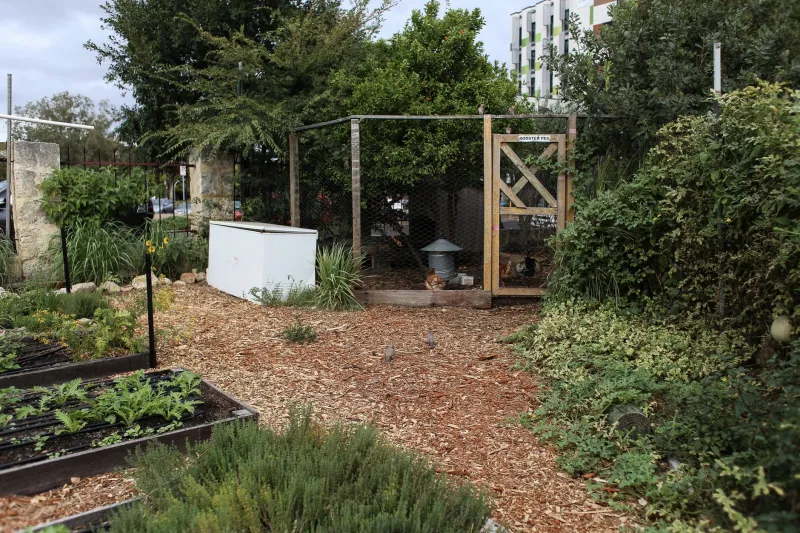
Backyard hens. Banned outright or restricted so tightly (lot size minimums, coop setbacks, neighbor consent requirements) that they're functionally illegal for most suburban lots.
Front-yard gardens. Some cities require 30–50% of a front yard to be planted with approved ground cover. Food, in this framework, is not approved.
Farm stands. Roadside sales of your own produce often require commercial zoning, a permit, and sometimes a parking lot. Yes, a parking lot, for a card table of sweet corn.
Beekeeping. Hive restrictions in many cities predate modern urban beekeeping entirely and were written when the concern was roaming livestock, not a backyard superorganism that pollinates the whole neighborhood.
The cumulative effect: we've legally zoned food production out of the places people actually live, then wondered why eating locally is so hard.
The People Who Fought City Hall (and Won)
When Derek and Jessica Chen wanted four hens in their Orlando subdivision, they discovered the ordinance prohibited poultry on lots under one acre. Rather than give up, they spent eight months doing homework: they gathered 300 signatures, presented research on noise and odor complaints from cities that had legalized hens (spoiler: there were almost none), and showed up to every planning commission meeting with a folder of case studies from Austin, Seattle, and Denver. The ordinance changed. Their neighbors, initially skeptical, now trade eggs for tomatoes.
In Kansas City, Missouri, the story scaled up. Cultivate KC and other advocates pushed through a comprehensive urban agriculture ordinance overhaul that legalized garden stands, expanded where food could be grown commercially, and streamlined the permitting process. It passed in 2016 and has since become a model other cities copy.
The common thread in every successful fight: persistence, paperwork, and showing up. Zoning changes aren't won with petitions alone. They're won in committee meetings at 7 p.m. on Tuesdays, with the same five people in the room.
Your Toolkit for Changing the Rules on Your Block
If you're ready to legalize food where you live, here's the playbook that keeps working:
1. Read your code. Search your city's municipal code online for terms like "poultry," "agriculture," "garden," and "home occupation." Screenshot everything. You can't fight what you can't cite.
2. Find your allies. Community gardens, food policy councils, and extension offices have usually been down this road. A local food policy council can turn one gardener's complaint into a coalition.
3. Study the winners. The AARP/SELCA model ordinances and the Sustainable Economies Law Center's library offer pre-vetted legal language your planning department can actually adopt. Giving officials a ready-made ordinance removes their biggest excuse.
4. Lead with complaints data. Every city that's legalized hens has the same story: enforcement calls dropped after legalization, because legal coops get maintained and illegal ones get hidden.
5. Bring the boring energy. Planning commissions respond to process, not passion. Submit written comments. Request the ordinance be placed on a work session agenda. Follow up in writing.
6. Celebrate loudly when you win. Every hens-legalized, garden-welcoming ordinance makes the next city's fight easier, because officials can now point to a peer municipality that survived.
Why This Matters More Than One Garden
A front-yard tomato patch won't fix the food system. But the rules that ban it encode a deeper assumption — that food production belongs somewhere else, out of sight, done by someone else. Changing that assumption, lot by lot and ordinance by ordinance, is unglamorous work. It's also the work that makes everything else — the markets, the CSAs, the regional food webs — legally possible.
The most radical thing you can grow this year might be a zoning amendment.