You're Not Really Paying for Strawberries: The Actual Math Behind U-Pick Pricing
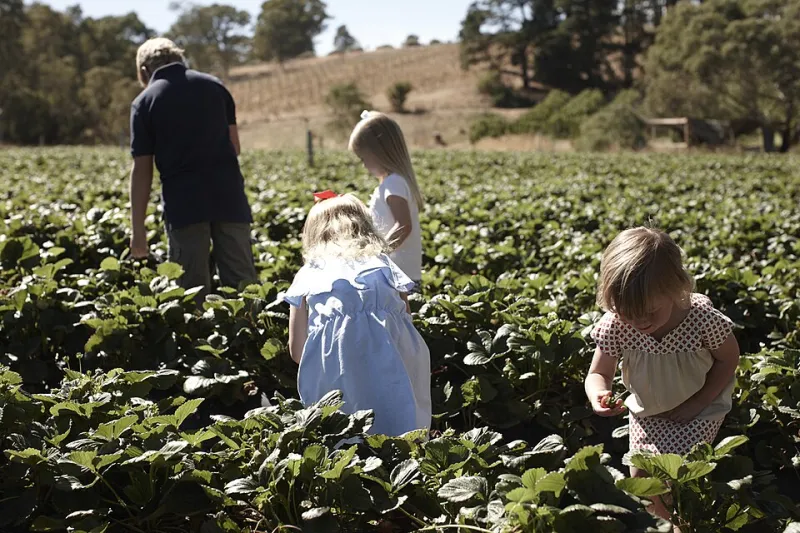
Photo: Unknown authorUnknown author, CC BY-SA 4.0, via Wikimedia Commons
Every May and June, someone on the internet picks up a calculator and figures out that pick-your-own strawberries cost more per pound than the plastic clamshell at the grocery store, and then writes a post about being ripped off. And every year, the post gets shared several thousand times.
I want to take that calculation seriously instead of dismissing it, because it's a real question. Why does doing the labor yourself cost more than letting someone else do it?
Short answer: it doesn't. That's not what you're buying. But the long answer is more useful.
First, What's Actually in the Flat
Let's start with the sticker. At a typical U-pick operation, you might pay an entry or container fee per person, then a per-pound rate on what you harvest. Total it up, compare it to store-bought, and yes — you're often paying a premium of twenty to fifty percent.
Now consider what you're carrying home. You picked it four hours ago. It's a fully ripe berry at peak sugar, a variety cultivated for flavor rather than for its ability to survive a thousand-mile refrigerated haul. The grocery store strawberry was bred for structural integrity, picked well before ripe, and gassed on arrival to bring the color back. It is a completely different product that happens to share a name.
That's not nothing. But it's also not the whole explanation. Because the U-pick advantage in ripeness exists whether or not anyone charges a premium, and there are plenty of cheaper farm stands.
The Insurance Nobody Puts on the Sign
Here's the line item most people never see. When a farm opens its fields to the public, it becomes, in insurance terms, an entertainment venue. That changes everything.
Standard farm liability coverage does not automatically cover members of the public wandering your rows. Agritourism coverage does, and it costs meaningfully more — sometimes several times more. The premiums rise with visitor counts, with parking areas, with whether there are animals, with whether there's a hayride, and with the general undefinable hazard of small children near the edges of a pond.
Add the things the sign requires: restrooms that meet public accommodation standards, ADA access, a parking area that handles two hundred cars on a Saturday, staff to direct traffic, sanitation, signage, a hand-washing station at the exit. A working farm is a place where people get muddy and step in things. A farm open to the public is a place where liability is measured in square feet.
You Are Paying for the Berries Somebody Else Ruined
This is the one that surprises people. Pick-your-own is, pound for pound, harder on a crop than commercial harvest. Customers step on rows. They pick a berry, change their mind, and drop it. They pick into a container that hasn't been chilled. They bring a toddler who treats a strawberry bed like a sandbox.
Growers I've spoken with estimate yield loss on U-pick fields running well above what a trained crew would cost them. That loss is not a scandal — it's baked into the price because it has to be. You're paying for the berries that were damaged, dropped, sat in a warm bucket, or crushed underfoot, because the farm still has to cover the cost of growing them.
Which is, honestly, a strange thing to be paying for, until you remember what an alternative would look like: a farm that gates off the good rows, charges a premium for a canned "experience," and hands you pre-picked fruit anyway. Plenty do. That's a worse deal and a worse afternoon.
The Experience Is Not a Scam Just Because It's an Experience
Here's where I part ways with the calculator crowd. The premium isn't only covering farm overhead. It's covering access to a thing that has become genuinely scarce: a place where your kid learns that a strawberry grows on the ground and not in a plastic box, in a country where that knowledge is two generations from extinction.
You can call that agritourism, or the experience economy, or a very expensive photo backdrop. All of those are true. But the fact that something is experiential doesn't make it fake. People pay premiums for brewery tours, farm dinners, and apple orchards in October without writing blog posts about how they got ripped off.
The difference is that strawberries feel like groceries, and groceries feel like something you should be able to buy cheaply. That expectation is doing a lot of quiet work here. It's the product of an agricultural system that optimized for cheap calories above nearly everything else, and the reason U-pick pricing feels transgressive is that it's charging what small-scale fruit actually costs to grow without the subsidy of a supply chain that treats land and labor as near-free inputs.
So Is the Premium Fair?
Mostly, yes — with caveats worth naming.
U-pick pricing becomes unfair when the farm charges a per-person entry fee and a high per-pound rate and the fields are picked over. It becomes unfair when the fruit is thin and the staff shrug. It becomes unfair when the premium is extracted from families who drove ninety minutes and can't exactly turn around.
But when the fields are full, the price per pound is posted clearly, and the entry fee is modest or waived — that's a fair trade between a farm trying to survive on narrow margins and a household buying something the grocery store genuinely cannot sell them.
My advice, as someone who's paid both ways: go early in the season, go on a weekday, ask the farm how many visitors they cap per day, and skip the operation where the parking lot has a shuttle bus. And stop doing the per-pound math against the supermarket. You aren't buying the same thing. You never were.